THE LORE ARCHIVES
LORE was never only a website. Long before its online features, interviews and literary criticism became part of the weird-fiction web, LORE existed as an independent magazine devoted to horror, dark fantasy, science fiction and imaginative literature. This archive preserves the publication history of LORE, its magazines, collections, writers and artists.
In 1995, three enthusiasts of horror and fantastic fiction — Rod Heather, Sean O’Leary and Joe Martucci — began publishing a new independent magazine from New Jersey.
They called it LORE.
What began as a small independent publication developed into an award-winning magazine featuring established authors alongside emerging voices, striking fantastic artwork and fiction that moved freely between horror, fantasy, science fiction and the weird.
During its original run, LORE published work associated with writers and artists including Harlan Ellison, Brian Lumley, Brian McNaughton, Jeffrey Thomas and Richard Corben.
Nine issues appeared before publication ceased around the turn of the millennium.
But LORE was not finished.
LORE: 1995 → 2000 → 2011 → 2012
After more than a decade of silence, LORE returned. A retrospective collection appeared in 2011, followed in April 2012 by LORE Volume 2, Number 1 — the first completely new issue in more than ten years.
The Original LORE Magazine
The first incarnation of LORE began in 1995.
In a later interview, editor and publisher Rod Heather remembered the beginnings of the magazine with striking simplicity: three people who loved horror fiction decided to create the sort of publication they themselves wanted to read.
The original team consisted of Heather, Sean O’Leary and Joe Martucci. As the magazine developed, its circle expanded and eventually included figures such as Jeffrey Thomas, Brian McNaughton and John Picinich.
The result was an independent magazine with an increasingly recognizable identity: strange fiction, strong visual presentation and an enthusiasm for material that did not always fit comfortably within conventional genre boundaries.
LORE HISTORY
The original LORE published nine issues. Contemporary accounts describe the magazine as beginning in New Jersey in 1995 and ending its first publishing run around 2000, when the time and resources required to maintain its standards became increasingly difficult for its editors to sustain.
Writers and Artists of LORE
One of the most remarkable aspects of LORE’s history is the range of people who appeared in or became associated with the magazine.
Among the names connected with its pages were:
- Harlan Ellison
- Brian Lumley
- Brian McNaughton
- Jeffrey Thomas
- Tom Piccirilli
- Elizabeth Massie
- Richard Corben
LORE’s fiction also accumulated recognition beyond the magazine itself. Contemporary descriptions of the publication note that stories appearing in LORE went on to receive major awards and honorable mentions in influential year’s-best collections.
That history is important because LORE existed in a particularly fertile period for independent horror and weird-fiction publishing.
Small magazines could provide a home for fiction that was too unusual, too dark or simply too difficult to classify for more conventional markets.
LORE Goes Silent
Independent magazines are difficult things to keep alive.
LORE’s first disappearance was not caused by a lack of enthusiasm for the material. Heather later explained that producing the magazine required both money and enormous amounts of time. As professional and personal responsibilities increased, maintaining the standard the editors expected became increasingly difficult.
Rather than allow the quality to deteriorate, publication stopped.
For more than a decade, the original issues remained artifacts of an earlier era of independent horror publishing.
Then the dead began to stir.
THE RETURN OF LORE
In 2011 and 2012 LORE emerged from its long hiatus. The revived publication was sometimes described as LORE 2.0: a continuation of the original magazine, but with improved production values and an expanded interest in horror, science fiction and fantasy.
LORE: A Quaint and Curious Volume of Selected Stories
Before the first completely new issue appeared, LORE returned to its own history.
In November 2011, LORE: A Quaint and Curious Volume of Selected Stories collected notable fiction from the magazine’s original run.
The anthology contained fourteen stories plus a collaborative round-robin tale and brought together work by authors including Harlan Ellison, Brian McNaughton, Brian Lumley and Elizabeth Massie.
LORE PUBLICATION
LORE: A Quaint and Curious Volume of Selected Stories
Published: 2011
Editors: Rod Heather & Sean O’Leary
Type: Retrospective fiction collection
The volume brought stories from the original LORE back into print and served as a bridge between the magazine’s first incarnation and its return.
The Challenge From Below
Among the anthology’s particularly interesting contents was the Lovecraftian collaborative story “The Challenge From Below”, featuring contributions by Robert M. Price, Peter Cannon, Donald R. Burleson and Brian McNaughton.
For the modern LORE archive, this story is especially relevant because it connects the magazine directly with the continuing literary tradition surrounding H. P. Lovecraft and the Cthulhu Mythos.
That tradition remains one of the central subjects of LORE Online today.
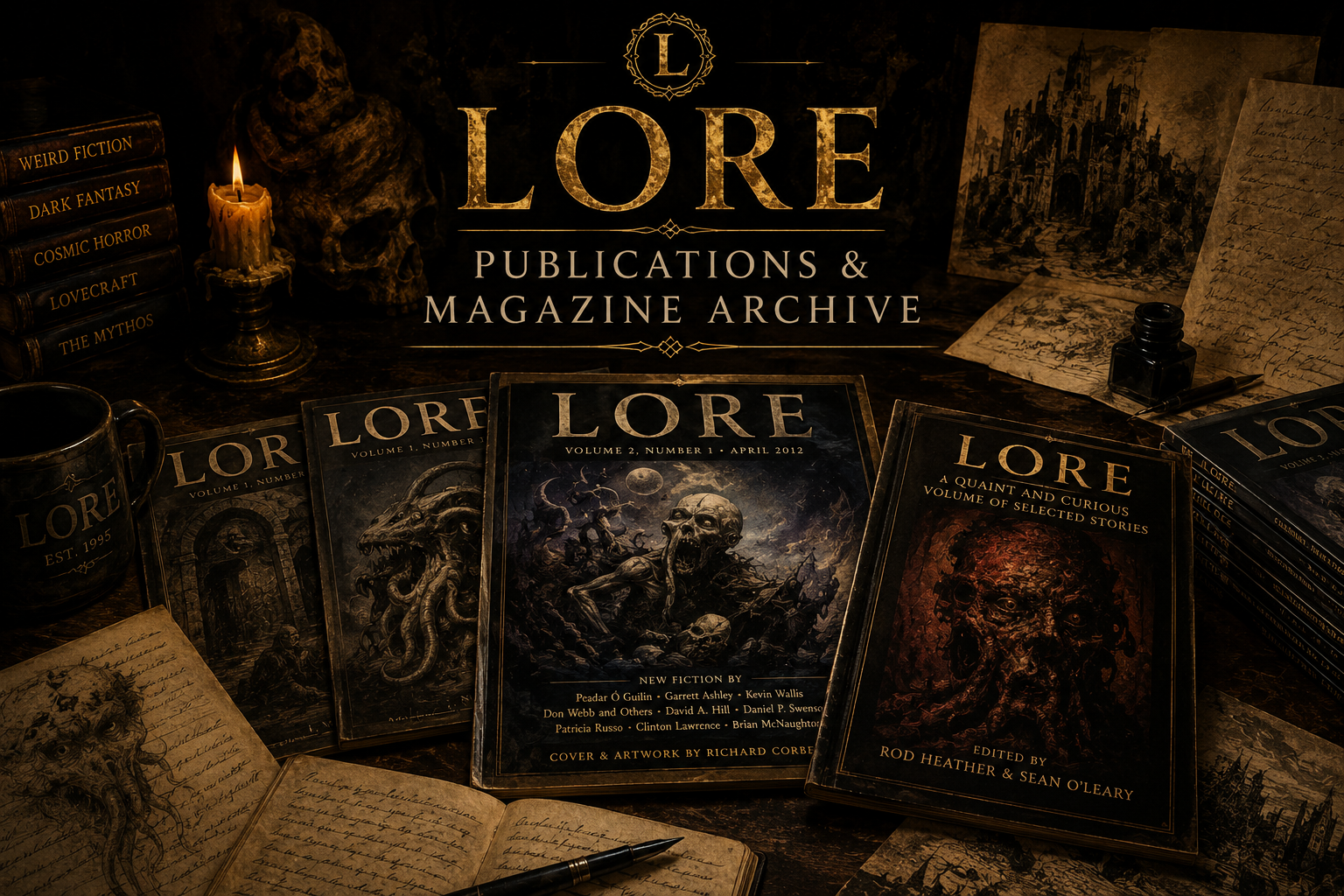
LORE Volume 2, Number 1 – April 2012
The full resurrection arrived in April 2012.
LORE Volume 2, Number 1 — often shortened to LORE 2.1 — was the first collection of completely new LORE fiction in more than a decade.
It was more than a nostalgic revival.
The new incarnation introduced improved production values, perfect binding and a full-color wraparound cover by legendary fantasy and horror artist Richard Corben.
RICHARD CORBEN & LORE
Corben’s relationship with LORE stretched back into the magazine’s original run. He supplied artwork for several earlier issues and returned to create the full-color wraparound cover for LORE 2.1. The artwork was subsequently selected for inclusion in Spectrum 19.
Inside LORE 2.1
The revived issue presented nine works of horror, science fiction, fantasy and strange fiction:
- “Fairy Gold” — Peadar Ó Guilín
- “Picking Roses For Chateelet” — Garrett Ashley
- “Wait” — Kevin Wallis
- “Splash” — Don Webb, Richard Lupoff, Scott Cupp, Michael Kurland, Michael Mallory, Paul Di Filippo and Jim Kelly
- “Toll and Trouble” — David A. Hill
- “Lonely, Lonely” — Daniel P. Swenson
- “She Wanted to Go Into the Trees” — Patricia Russo
- “The Spacetime Subway Station” — Clinton Lawrence
- “The Deposition of Leodiel Fand” — Brian McNaughton
Tangent Online reviewed the issue shortly after publication and described the revived LORE as an award-winning magazine returning after a hiatus of more than a decade. Its reviewer particularly noted the issue’s preference for strange worlds and fiction with a poetic sensibility.
The Deposition of Leodiel Fand
The final work in LORE 2.1 had an extraordinary history.
Brian McNaughton, author of the World Fantasy Award-winning The Throne of Bones, had been closely connected with the original LORE.
In 2004, McNaughton sent the editors an unfinished work titled “The Deposition of Leodiel Fand.”
It returned to the grotesque world of Seelura, familiar from The Throne of Bones.
McNaughton died before completing it.
The surviving manuscript was substantial — Rod Heather later estimated it at more than 16,000 words — and LORE preserved it for years.
When the magazine finally returned, Heather and O’Leary chose McNaughton’s unfinished story for the first new issue.
A piece of lost weird fiction
LORE 2.1 therefore contains something unusual: a substantial previously unpublished return to Brian McNaughton’s Seelura, preserved by people who had known and worked with him and finally published years after his death.
LORE and Richard Corben
Richard Corben’s contribution to LORE went much deeper than a single revival cover.
Heather recalled beginning correspondence with Corben during the mid-1990s. Corben supported the young magazine and eventually supplied covers for several issues of the original run.
He was also featured as an artist within LORE and produced an illustration for John Glasby’s Return to Y’Ha-Nthlei.
The relationship was particularly appropriate for a magazine with deep roots in weird and Lovecraftian fiction. Corben’s grotesque, muscular and immediately recognizable artwork had long been associated with fantasy, horror and adaptations of writers such as Edgar Allan Poe and H. P. Lovecraft.
What Kind of Magazine Was LORE?
LORE resisted an overly narrow definition.
The revived magazine described itself as publishing interstitial speculative fiction. Horror remained fundamental to its identity, but the second incarnation explicitly expanded its scope to include science fiction and fantasy.
That philosophy explains why the contents could move from dark fantasy to cosmic horror, strange cities, speculative concepts and grotesque worlds without appearing out of place.
The connecting element was imagination.
And frequently, strangeness.
LORE’s Place in Independent Horror Publishing
The importance of publications such as LORE is easier to understand when viewed in the context of the pre-social-media literary world.
Independent magazines acted as meeting places.
Editors discovered writers. Writers encountered artists. Readers found authors they might never have encountered through mainstream publishing. Stories moved from magazines into anthologies, award lists and larger collections.
LORE belonged to that ecosystem.
Its history also overlaps directly with the modern weird-fiction revival and with writers, critics and artists associated with Lovecraft studies.
That makes its surviving publication history valuable beyond simple nostalgia.
WHY THIS ARCHIVE EXISTS
Old independent magazines are unusually vulnerable to disappearing from the web. Stores close, domains change, CMS systems are replaced and old product pages vanish. LORE Online is rebuilding this publication record so that the magazine’s history, contributors and connections to weird fiction remain discoverable.
From the LORE Store to the LORE Archive
Earlier versions of this website maintained a dedicated LORE Store.
The historical address was:
/index.php/store
The store offered LORE publications directly to readers. In 2012, contemporary sources listed LORE 2.1 at $10.95 plus shipping and LORE: A Collection of Quaint & Curious Selected Stories at $14.95 plus shipping.
That store no longer exists.
Instead of allowing its URL and history to disappear, the old store address now leads here — to the permanent LORE Publications Archive.
Remarkably, Tangent Online’s historical directory of bi-annual magazines still records the old LORE Store URL as the magazine’s website. The surviving external link is one of the reasons this page has been restored.
Explore the Recovered LORE Archive
The Publications Archive is part of a larger effort to recover significant material from previous versions of LORE Online.
Literary Influence
Explore Edgar Allan Poe’s influence on H. P. Lovecraft and the development of his literary imagination.
Recovered Interview
LORE Chats with Thomas Ligotti
Return to LORE’s recovered 2013 conversation with one of modern weird fiction’s most distinctive voices.
Lovecraft Studies
Continue into LORE’s recovered archive of Lovecraft scholarship and weird-fiction criticism.
The Archive Is Still Growing
This page is not intended to be the final word on LORE’s publishing history.
It is the beginning of a reconstructed catalogue.
As reliable information, cover artwork, tables of contents and surviving records of individual issues are recovered, they can be added here and eventually expanded into dedicated pages for each publication.
The long-term goal is to document the nine original LORE issues, the 2011 retrospective collection, the revived magazine and the writers and artists who passed through its pages.
LORE ARCHIVE RECORD
Recovered historical URL:
/index.php/store
Original purpose:
LORE Magazine store and publication ordering page
Current destination:
/publications/
Recovery status: Restored as the permanent LORE Publications & Magazine Archive. Historical publication details are reconstructed from surviving contemporary reviews, interviews, bibliographic records and references to the original LORE website.
Part of the LORE Online Recovery Project — preserving the magazine, interviews, criticism and weird-fiction history of earlier incarnations of LORE.