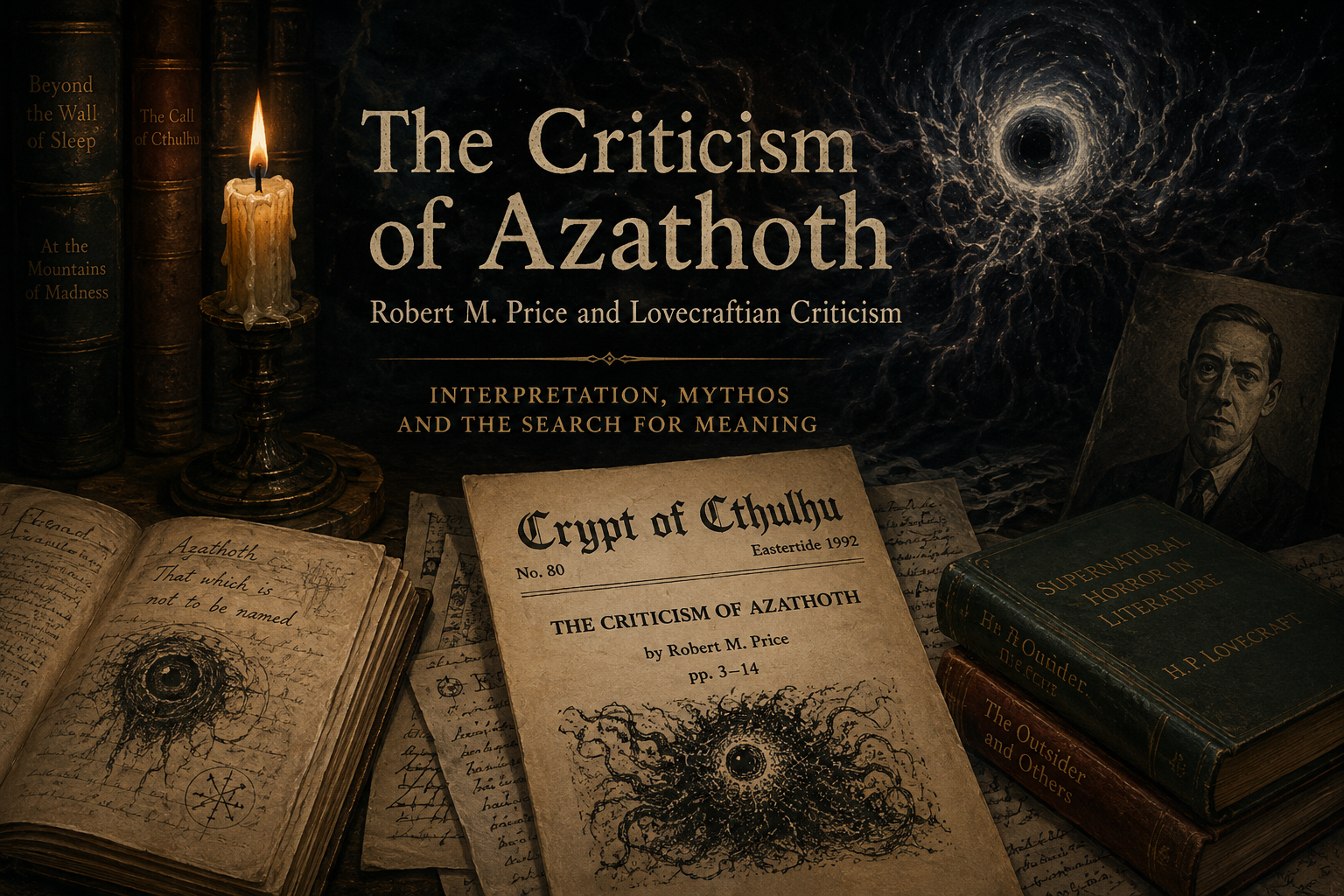
🕯️ In brief: The Criticism of Azathoth is an essay by Lovecraft scholar Robert M. Price, originally published in Crypt of Cthulhu #80 in 1992. The essay challenges the idea that there is one definitive way to interpret H. P. Lovecraft and the Cthulhu Mythos. Its larger question remains surprisingly modern: when we interpret Lovecraft, are we discovering a system that was already present in the stories – or creating one ourselves?
This page reconstructs the subject and historical context of a feature once available through LORE Online. It does not reproduce Price’s original essay. Instead, it offers a new exploration of the critical debate surrounding Lovecraft, interpretation and the strange mythology that grew around his fiction.
📜 What Is The Criticism of Azathoth?
The Criticism of Azathoth is an essay by Robert M. Price dealing with one of the most fascinating problems in Lovecraft scholarship: how should H. P. Lovecraft’s fictional universe actually be interpreted?
The essay originally appeared in Crypt of Cthulhu #80 in 1992, occupying pages 3–14 of the issue.
That context matters. Crypt of Cthulhu was devoted to Lovecraft, his circle, the Cthulhu Mythos and the growing body of criticism surrounding weird fiction. Price was not merely contributing from outside that community. He was one of the central figures in the publication and in the wider discussion of Lovecraftian literature.
📚 Historical record
Title: The Criticism of Azathoth
Author: Robert M. Price
Publication: Crypt of Cthulhu #80
Year: 1992
Pages: 3–14
Subject: H. P. Lovecraft, literary criticism and interpretation of the Cthulhu Mythos
The unusual title is fitting. Azathoth is one of Lovecraft’s most enigmatic cosmic entities, associated with chaos, incomprehensibility and a universe profoundly indifferent to human expectations.
Using Azathoth in the title of an essay about literary criticism therefore suggests something larger than a discussion of a fictional monster.
It points toward the chaos that can emerge when readers, critics and later writers attempt to impose a single orderly interpretation upon Lovecraft’s strange fictional universe.
👁️ The central problem: what does Lovecraft actually mean?
At first glance, this seems like an easy question.
Read the stories. Identify the creatures. Compare the fictional books, places and gods. Construct a mythology.
But Lovecraft’s fiction resists that approach.
Names recur from story to story, yet their meanings are not always stable. Cosmic entities appear without being placed into a precise hierarchy. Narrators misunderstand what they encounter. Ancient books offer fragments rather than complete explanations.
The result is not a neatly constructed mythology comparable to a modern fictional encyclopedia.
It is something much stranger.
👁️ The problem at the heart of Lovecraftian criticism:
Are critics uncovering the hidden structure of Lovecraft’s fictional universe – or constructing that structure themselves?
This distinction became increasingly important as Lovecraft’s fiction passed from the author to his correspondents, collaborators, publishers, critics and generations of later Mythos writers.
🐙 Did Lovecraft create the Cthulhu Mythos?
Today, the phrase Cthulhu Mythos feels inseparable from Lovecraft.
But that can create a misleading impression.
Lovecraft certainly reused names, books, locations, ideas and cosmic beings throughout his fiction. Yog-Sothoth, Cthulhu, Nyarlathotep, Azathoth, Arkham, Miskatonic University and the Necronomicon helped create connections between otherwise independent stories.
Yet this does not necessarily mean Lovecraft was constructing a rigid mythological system with fixed categories and relationships.
🕸️ A useful distinction
Shared fictional elements are not necessarily the same thing as a systematic mythology.
Lovecraft repeatedly connected his stories, but he also valued ambiguity, suggestion and the sensation that humanity understands only fragments of a much larger reality.
This is one reason the Cthulhu Mythos became such fertile ground for later writers.
Lovecraft left gaps.
Those gaps invited interpretation.
And interpretation eventually became expansion.
🕯️ Lovecraft versus Derleth
No discussion of Lovecraftian interpretation can avoid August Derleth.
Derleth played an enormously important role in preserving and publishing Lovecraft’s work after Lovecraft’s death. But his interpretation of the Mythos also became one of the most debated subjects in Lovecraft scholarship.
Later Mythos fiction associated with Derleth tended toward a more organized cosmology. Entities could be classified and relationships between supernatural forces became more explicit.
This produced something much easier to understand as a coherent mythology.
But was it Lovecraft’s mythology?
🦇 The critical question:
When a later writer organizes Lovecraft’s fragments into a consistent system, has that writer discovered Lovecraft’s hidden design – or created a new interpretation?
This question became one of the defining debates in Lovecraft studies.
🌌 Cosmicism changes the picture
Another major way of reading Lovecraft focuses less on cataloguing fictional gods and more on his philosophical outlook.
This approach emphasizes what is commonly called cosmicism.
Human beings occupy no privileged position in the universe. The cosmos is unimaginably ancient, vast and indifferent. Human morality does not necessarily apply beyond humanity, and knowledge itself may reveal truths our species is psychologically unprepared to accept.
From this perspective, Lovecraftian horror does not require a cosmic battle between good and evil.
The universe does not have to hate us.
It merely has to be indifferent to us.
🌌 Cosmic horror becomes terrifying precisely because humanity may not matter at all.
This philosophical reading has had enormous influence on modern understandings of Lovecraft.
But it also illustrates Price’s larger critical problem: every interpretive framework emphasizes certain aspects of the fiction while reducing the importance of others.
📖 Reader, author and critic
This brings us to one of the most interesting ideas surrounding The Criticism of Azathoth.
Who ultimately determines what a literary work means?
The author?
The text itself?
The critic?
Or the reader?
Traditional literary criticism often searches for authorial intention: what was Lovecraft trying to say?
Other approaches focus on the text independent of the author’s intentions.
Still others emphasize the role of readers and the cultural environment in which a work is interpreted.
👁️ Consider the possibilities:
- Lovecraft may have intended one meaning.
- The text may permit several meanings.
- Later writers may transform those meanings.
- Critics may identify patterns Lovecraft never consciously planned.
- Readers may construct yet another interpretation.
The Cthulhu Mythos is particularly interesting because all of these processes have been occurring for almost a century.
🕸️ Lovecraft and deconstruction
The discussion surrounding Price’s essay has often been connected with ideas associated with deconstructive literary criticism.
In simplified terms, deconstruction challenges the assumption that a text necessarily contains one stable, final meaning waiting to be uncovered by the perfect critic.
Language is complicated. Meanings depend upon relationships between words, cultural assumptions and other texts. A work can contain tensions and contradictions that make a single definitive interpretation difficult or impossible.
Lovecraft provides unusually fertile territory for this kind of reading.
His fictional universe is constructed from fragments:
- incomplete manuscripts
- forbidden books
- unreliable narrators
- half-deciphered inscriptions
- family histories
- academic speculation
- legends and folklore
- letters and testimonies
- discoveries that contradict accepted history
Even Lovecraft’s characters rarely possess the whole truth.
Why, then, should the reader expect a perfectly stable mythology?
🐙 Azathoth as the perfect symbol
The title The Criticism of Azathoth becomes particularly evocative when viewed from this perspective.
Azathoth represents one of the least human and least comfortably understandable presences associated with Lovecraft’s cosmic fiction.
Trying to reduce such a universe to a tidy diagram can therefore feel almost contrary to the effect Lovecraft sought to create.
The unknown is frightening because it remains unknown.
A completely explained Mythos risks becoming less horrific.
🕯️ The paradox of Lovecraft scholarship:
The more completely we catalogue the Mythos, the more we risk destroying the uncertainty that made it frightening in the first place.
📚 Different schools of Lovecraftian criticism
Over the decades, critics have approached Lovecraft from very different directions.
August Derleth helped popularize a systematic Mythos interpretation. Dirk W. Mosig challenged important assumptions about that interpretation. Donald R. Burleson explored Lovecraft through literary and theoretical approaches. S. T. Joshi became one of the most influential scholars in establishing Lovecraft’s texts, biography and philosophical context.
Robert M. Price contributed another distinctive voice, frequently examining how the Mythos itself developed through Lovecraft, his circle and later writers.
These approaches need not produce identical conclusions.
Indeed, their disagreements are part of what makes Lovecraft studies interesting.
| Critical question | Possible approach |
|---|---|
| Is the Mythos a coherent system? | Mythological interpretation |
| What did Lovecraft believe? | Biographical / philosophical criticism |
| How do the stories create meaning? | Textual / literary criticism |
| How did later writers transform the Mythos? | Reception and influence studies |
| Can a story possess one final meaning? | Post-structural / deconstructive reading |
👁️ So who is right?
Perhaps that is the wrong question.
Different interpretations can reveal different aspects of a literary work.
A philosophical interpretation can illuminate Lovecraft’s cosmic worldview. A biographical interpretation can connect his fiction with his letters and intellectual development. A textual analysis can reveal structures and contradictions within individual stories.
Meanwhile, studying Derleth and later Mythos writers tells us how Lovecraft’s fictional vocabulary evolved after his death.
The important distinction is between saying:
“This is one useful interpretation of Lovecraft.”
and
“This is the only possible meaning of Lovecraft.”
The first invites discussion.
The second ends it.
The Criticism of Azathoth belongs to a critical tradition that makes that distinction particularly important.
📜 Crypt of Cthulhu #80
The original publication context also deserves attention.
Crypt of Cthulhu #80 was not simply an issue containing Price’s essay. It provides a snapshot of Lovecraft scholarship and fandom in the early 1990s.
Alongside The Criticism of Azathoth, the issue contained S. T. Joshi’s The Rationale of Lovecraft’s Pseudonyms, Donald R. Burleson’s Strange High Houses: Lovecraft & Melville, Kieran Setiya’s Theology of the Other Gods and another Price essay, The Works of Robert Blake.
🦇 Why this matters:
Issue #80 shows that Lovecraft fandom was already deeply engaged with textual scholarship, philosophy, literary influence, bibliography and competing interpretations of the Mythos.
That intellectual history is worth preserving because today’s enormous Lovecraftian culture did not appear from nowhere.
It grew from decades of correspondence, amateur scholarship, specialist magazines, small presses, conventions and passionate readers.
🧠 Why The Criticism of Azathoth still matters
The questions raised around Price’s essay have become even more relevant as Lovecraft’s influence has expanded.
The Mythos now exists far beyond Lovecraft’s original fiction.
Later authors have added creatures, histories and relationships. Role-playing games have systematized cosmic entities so players can interact with them. Encyclopedias and online databases categorize fictional beings. Films, comics and games continually reinterpret Lovecraftian ideas.
Every adaptation requires interpretation.
And every interpretation changes the way audiences understand Lovecraft.
🐙 A Mythos that began as fragments has become a cultural universe.
Understanding how that transformation happened is one of the central tasks of Lovecraftian criticism.
🕯️ From Lovecraft to the modern Weird
There is also a broader literary story here.
Lovecraft inherited traditions from Edgar Allan Poe, Arthur Machen, Algernon Blackwood, Lord Dunsany and other writers of supernatural and fantastic literature.
Lovecraft transformed those influences into something recognizably his own.
Then Lovecraft himself became an influence.
Writers surrounding him borrowed names and fictional books. August Derleth and others expanded the Mythos. Later generations reinterpreted it again.
↓
H. P. Lovecraft
↓
Lovecraft Circle
↓
Cthulhu Mythos
↓
Lovecraftian Criticism
↓
Modern Weird & Cosmic Horror
At every stage, interpretation and creation overlap.
That may be one of the reasons the Mythos has survived so successfully.
📜 From the LORE Archive
The Criticism of Azathoth also has a place in the history of LORE Online itself.
An earlier version of LORE Online made material connected with the essay available through the historical Joomla URL:
/index.php/component/content/article/43-vault/81-mm4-3
External references to that address survived after the original LORE site disappeared, including a contextual link from a LibraryThing discussion devoted specifically to Lovecraftian criticism.
The existence of that link helps establish both the identity of the historical LORE page and its relevance to readers interested in Lovecraft scholarship.
🕯️ LORE Recovery Record
- Historical title: The Criticism of Azathoth
- Author: Robert M. Price
- Original publication: Crypt of Cthulhu #80
- Publication year: 1992
- Original pages: 3–14
- Historical LORE content ID: 81
- Historical section: Vault
- Topic: Lovecraftian criticism / Cthulhu Mythos / literary interpretation
- LORE recovery status: Reconstructed
This new page does not reproduce Robert M. Price’s original copyrighted essay. It preserves the bibliographic and historical trail of the former LORE feature while providing a newly written introduction to the critical questions surrounding it.
📚 Further exploration
Readers interested in this subject can explore Crypt of Cthulhu, Lovecraft scholarship and the history of the Cthulhu Mythos to see how dramatically interpretations of Lovecraft have changed over time.
The historical record of Crypt of Cthulhu #80 confirms The Criticism of Azathoth as the opening major essay of the issue, followed by contributions dealing with Lovecraft’s pseudonyms, literary connections and mythology.
That makes the issue itself a fascinating artifact from an important period in the development of modern Lovecraft scholarship.
👁️ The final paradox
There is something appropriately Lovecraftian about all of this.
Readers have spent decades attempting to understand a fictional universe whose power depends partly upon the idea that it cannot be completely understood.
We catalogue the entities.
We draw family trees.
We compare manuscripts.
We debate philosophies.
We construct timelines.
And every answer seems to uncover another question.
🕯️ Perhaps the perfect interpretation of the Cthulhu Mythos is the realization that there may never be a final interpretation.
That continuing debate is part of what keeps Lovecraft’s strange universe alive.
And it is precisely the kind of forgotten history, criticism and weird literature that the reconstructed LORE Online archive exists to explore.