From the LORE Archives
This feature restores a LORE interview originally published in 2013. The original page disappeared during earlier incarnations of the website. Contemporary references, surviving excerpts and discussions allow us to preserve the history and central themes of the conversation without pretending that every word of the lost original can be reconstructed.
In June 2013, readers of weird fiction encountered something unusual on LORE: a new conversation with Thomas Ligotti, one of modern horror literature’s most distinctive and elusive voices.
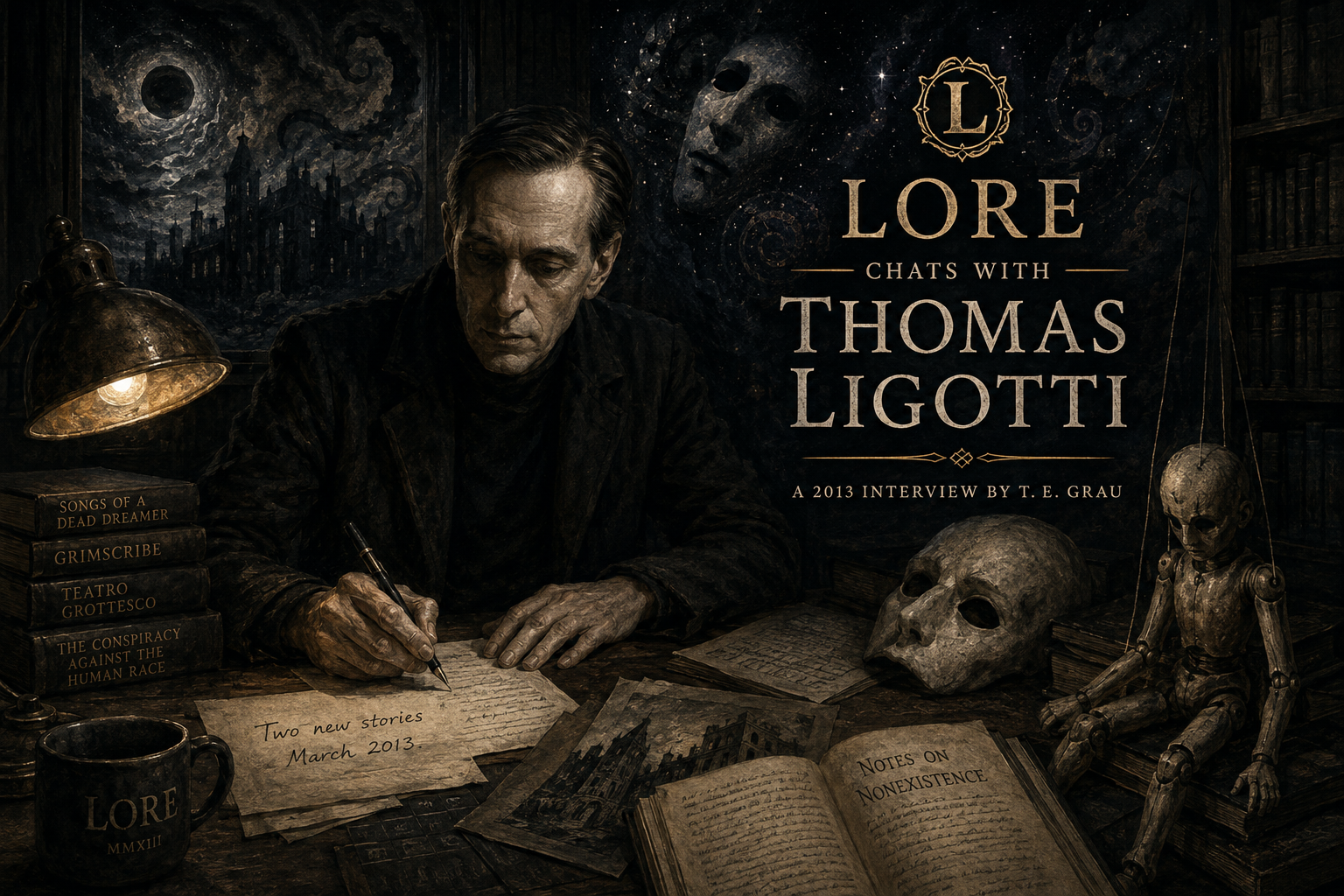
The interview was conducted for LORE by writer T. E. Grau at a particularly interesting moment in Ligotti’s career. For years, readers had wondered whether the author of Songs of a Dead Dreamer, Grimscribe and Teatro Grottesco would ever return to writing new fiction. Ligotti’s creative output had slowed dramatically, while his nonfiction work The Conspiracy Against the Human Race had brought the philosophical pessimism underlying much of his fiction into the foreground.
Then came unexpected news.
Ligotti told Grau that his imagination had begun to return—and that in March 2013 he had managed to complete two new stories.
For admirers of his work, the revelation transformed the interview into something more than a routine author conversation. It captured a transitional moment: a writer long associated with nightmares, alienation and the fragility of consciousness describing the uncertain return of the very faculty from which those nightmares had emerged.
Why this interview mattered
When the original LORE interview appeared, the most striking news was not the announcement of a new book or commercial project. It was simply that Thomas Ligotti was writing fiction again. Contemporary readers immediately noticed the significance: a LibraryThing discussion from June 2013 linked directly to the original LORE page and celebrated the news of two newly completed stories.
Thomas Ligotti and the Literature of the Nightmare
Thomas Ligotti occupies an unusual position in modern horror literature. His fiction participates in traditions established by writers such as Edgar Allan Poe, H. P. Lovecraft, Arthur Machen and other masters of supernatural literature, yet his work is immediately recognizable as his own.
His worlds are populated by abandoned districts, diseased towns, empty offices, theatres, factories, festivals, puppets, mannequins and figures whose apparent humanity cannot always be trusted. Everyday reality repeatedly appears to conceal another order of existence—one that is artificial, hostile or simply indifferent to human expectations.
The horror does not depend primarily upon monsters.
It comes from the suspicion that existence itself may be the monster.
LORE CONTEXT
This is one reason Ligotti belongs naturally within the world explored by LORE. Lovecraft’s cosmicism destabilizes humanity by revealing its insignificance within an incomprehensibly vast universe. Ligotti often moves the same destabilization inward, questioning consciousness, identity and even the assumption that being alive should automatically be regarded as desirable.
The Original 2013 LORE Conversation
The original feature was published under the title “LORE Chats with Thomas Ligotti.” Contemporary discussion confirms that it was circulating online by June 2013, when readers began sharing the LORE link and discussing Ligotti’s announcement that he had returned to short fiction.
T. E. Grau later described the conversation as unusually candid. The interview covered Ligotti’s writing, his long interruption in creative work, psychological and physical difficulties, pessimism, mortality and the uncertain possibility of producing further fiction.
That context is essential.
For Ligotti, the interruption was not presented as a calculated withdrawal from publishing. He explained that after 2001 his mental state deteriorated and the imaginative energy required for fiction became increasingly inaccessible.
During a brief improvement in late 2002, he managed to write two stories. After that, however, fiction largely receded from his life.
When the Imagination Disappeared
Writers frequently speak about “writer’s block,” but Ligotti’s description went considerably deeper. He did not merely describe an inability to find a plot or finish a manuscript. He described a loss of imaginative capacity itself.
His surviving account from the LORE conversation makes the distinction particularly important. Nonfiction remained possible during periods when fiction did not. Beginning around 2003, periods of improved concentration allowed him to work on the project that eventually became The Conspiracy Against the Human Race.
That book occupied him intermittently for years and was completed in 2010.
The divide between fiction and nonfiction in Ligotti’s account is revealing. Both may arise from similar philosophical territory, but they require different mental processes. The Conspiracy Against the Human Race could develop intellectually even when the imaginative machinery required to build Ligotti’s strange fictional environments was no longer functioning in the same way.
A crucial distinction
Ligotti did not describe abandoning fiction because he had rejected the form. Rather, fiction became something he could no longer reliably produce. That makes the announcement contained in the 2013 LORE interview—his return to two new stories—far more significant than an ordinary publication update.
The Conspiracy Against the Human Race
Published in its first book edition in 2010, The Conspiracy Against the Human Race: A Contrivance of Horror occupies a strange territory between literary criticism, philosophical pessimism and meditation on supernatural horror.
The book makes explicit many ideas that readers had long detected beneath Ligotti’s fiction: distrust of consciousness, scepticism toward conventional optimism and the unsettling possibility that human beings are creatures capable of understanding enough about existence to become horrified by it, but not enough to escape it.
That philosophical dimension helps explain why Ligotti cannot be reduced to a stylistic successor to Lovecraft.
There are obvious points of contact between them. Both writers build fiction around revelations that diminish the status of humanity. Both repeatedly undermine the comforting structures through which their characters understand reality. Both recognize that horror can arise not merely from danger but from knowledge.
But Ligotti pushes the problem of cosmic insignificance into the problem of consciousness itself.
For Lovecraft, the universe may be indifferent to us.
For Ligotti, the more disturbing possibility is that our awareness of ourselves may itself be part of the catastrophe.
Readers who want a broader introduction to Ligotti’s work can also consult the Thomas Ligotti author profile at Penguin Random House, which lists his major works and literary background.
2012: The Imagination Begins to Return
The chronology preserved from the LORE conversation becomes especially interesting in 2012.
Ligotti described that year as one in which severe physical experiences unexpectedly coincided with a gradual return of mood, ambition and imagination. He began writing poetry again and started assembling material for a collection of his interviews.
That interview collection eventually became Born to Fear: Interviews with Thomas Ligotti, edited by Matt Cardin.
But the crucial change came the following year.
March 2013: Two New Thomas Ligotti Stories
In March 2013, Ligotti’s imagination had recovered sufficiently for him to finish two new works of fiction.
The original LORE interview did not present this development as the beginning of a triumphant new phase. Ligotti remained characteristically cautious. He did not promise a steady stream of new stories, nor did he claim that his difficulties had disappeared.
That uncertainty makes the moment more compelling.
After years in which fiction appeared to have become impossible, two stories existed where previously there had been none.
Readers quickly noticed.
On June 23, 2013, a LibraryThing user shared the original LORE URL and highlighted exactly this news: Ligotti’s creative block had eased sufficiently for him to produce two new stories that year. Other participants called the interview fascinating and immediately began discussing Ligotti’s work.
For readers in 2013, the remarkable news was simple:
Thomas Ligotti was writing fiction again.
What Became of the New Fiction?
The return hinted at in the LORE interview did not remain merely an intriguing footnote.
Ligotti’s later work demonstrated that the resurgence of his imagination had produced significant fiction. In 2014, Subterranean Press published The Spectral Link, containing the novellas Metaphysica Morum and The Small People.
Seen from that later perspective, the LORE conversation becomes a particularly valuable snapshot.
Readers were hearing about a creative return before its full literary consequences were visible.
That is one of the reasons restoring this page matters.
Thomas Ligotti and H. P. Lovecraft
For a website devoted to the world surrounding H. P. Lovecraft, Ligotti is an especially important figure.
His relationship with Lovecraft is not simply one of imitation. Ligotti absorbed elements of the Lovecraftian tradition and transformed them into an intensely personal form of philosophical horror.
Lovecraft often begins with a recognizable world and gradually tears away its protective surface. Behind local history, genealogy, archaeology or astronomy lies a universe older, stranger and vastly less human than anyone suspected.
Ligotti frequently performs a comparable operation with ordinary existence.
A workplace ceases to be merely a workplace. A town no longer behaves like a town. Human figures resemble dolls, puppets or badly constructed replicas. Institutions appear to operate according to rules that cannot be understood. The everyday world becomes theatrical scenery erected over an abyss.
This is cosmic horror translated into a different register.
LOVECRAFTIAN CONNECTION
Lovecraft’s characters discover that humanity is insignificant within the cosmos. Ligotti’s characters often discover something even more intimate: that the human world, human identity and human consciousness may never have possessed the solidity they assumed.
Poe, Lovecraft and the Lineage of Weird Fiction
Ligotti’s literary ancestry also leads further back through Lovecraft to Edgar Allan Poe.
Poe demonstrated that supernatural literature could emerge from psychological states, unreliable perception, obsession and the aesthetic construction of dread. Lovecraft expanded that dread outward into deep time and cosmic space. Ligotti inherited both possibilities.
His fiction can therefore feel simultaneously internal and cosmic.
The universe may be wrong, but so may the mind that perceives it.
This connection also makes the restored LORE archive increasingly useful as a network rather than a collection of isolated pages. Readers interested in this literary lineage may continue with our feature Lovecraft and Ligeia: Edgar Allan Poe’s Influence on H. P. Lovecraft, which examines how Poe helped shape Lovecraft’s own development.
Why Ligotti’s Horror Feels Different
Ligotti is frequently grouped with cosmic horror writers, but the label only explains part of his effect.
1. Horror without reassurance
Many horror narratives eventually restore order. The monster is defeated, the mystery solved, or at least the boundaries separating normal life from supernatural disruption are re-established.
Ligotti rarely offers that comfort.
The disturbing revelation is often not an intrusion into reality. It may be the true nature of reality.
2. The artificial human
Puppets, mannequins, masks, dolls and theatrical imagery recur throughout Ligotti’s work because they attack a fundamental assumption: that we are autonomous beings directing our own lives.
The puppet is frightening precisely because it resembles us while making visible the possibility that agency is an illusion.
3. Place as nightmare
Ligotti’s cities and towns often feel disconnected from ordinary geography. Streets seem to lead into psychological or metaphysical territory. Buildings become stages. Factories become systems. Offices acquire an almost supernatural hostility.
The setting is not merely where the horror happens.
The setting is the horror.
4. Philosophical dread
Perhaps most distinctive is Ligotti’s refusal to separate supernatural horror entirely from philosophical pessimism.
The frightening question is not always “What is hiding in the darkness?”
Sometimes it is:
What if the darkness is simply an accurate description of things?
The Writer Behind the Darkness
The surviving material from the LORE interview also complicates the temptation to treat Ligotti merely as a literary persona.
His work is so stylistically unified—so saturated with dread, pessimism, puppetry, artificiality, death and unstable reality—that it is easy to imagine “Thomas Ligotti” as another mask inside one of his own stories.
Yet the 2013 conversation showed the practical human circumstances behind periods of literary production and silence.
Writing was not an abstract philosophical exercise. Ligotti described creativity as something closely tied to his ability to function and to put distance between himself and thoughts of mortality.
That makes the interview uncomfortable in places, but also unusually revealing.
The relationship between the author’s philosophy and his fiction cannot simply be reduced to autobiography. Nevertheless, the conversation demonstrates how seriously Ligotti engaged with themes that other writers might employ merely for atmosphere.
A Rare Moment in Weird-Fiction History
Looking back from the present, it is easy to underestimate how uncertain Ligotti’s future as a fiction writer appeared at the time.
Teatro Grottesco had established itself as one of the major collections of contemporary weird fiction, but readers had little reason to assume that another significant body of new stories was imminent.
The LORE interview therefore caught a small but meaningful historical moment between silence and return.
It also illustrates something important about the literary web of the early 2010s.
Interviews published by genre magazines and independent websites could circulate through forums, blogs and reading communities, generating discussion far beyond the original publication.
The surviving LibraryThing discussion is evidence of exactly that process.
A LORE feature was published.
A reader discovered it.
The link was shared.
Other readers discussed Ligotti.
More than a decade later, that same link helps us identify what once occupied a page that had otherwise vanished.
Why LORE is restoring this page
Old websites disappear in pieces. A redesign changes a URL. A CMS is replaced. Images vanish. Databases are abandoned. Eventually search engines and readers encounter nothing but broken links.
The LORE Recovery Project is intended to reverse that process wherever sufficient evidence survives. Rather than redirect historically important URLs to unrelated pages, we reconstruct their subject, context and place within the archive.
The Legacy of “LORE Chats with Thomas Ligotti”
The significance of the original interview lies partly in what happened afterward.
Ligotti did return to fiction. His work continued to receive wider recognition. Penguin Classics published Songs of a Dead Dreamer and Grimscribe together in 2015, placing two foundational Ligotti collections within one of the world’s most recognizable literary series. Penguin describes his horror as influenced by Lovecraft, Poe and Kafka while emphasizing its distinct existential character.
His nonfiction has likewise remained influential. The Conspiracy Against the Human Race eventually reached a much broader readership and continues to provoke discussion well outside traditional horror fandom.
But in June 2013, none of that future history could simply be assumed.
There was only an interview, an author uncertain whether he would write further stories, and the extraordinary fact that after years of creative silence, two new pieces of fiction had been completed.
That uncertainty is precisely what makes the original LORE moment worth preserving.
Thomas Ligotti in the Lovecraftian Tradition
There is a tendency to describe every writer of cosmic or philosophical horror as “Lovecraftian.” Used carelessly, the term tells us very little.
Ligotti is interesting because his connection with Lovecraft operates at a deeper level.
He does not need Cthulhu, Arkham or the Necronomicon to continue a Lovecraftian tradition.
Instead, he inherits a method of horror:
- destroy the assumption that humanity occupies a privileged position;
- undermine confidence in ordinary reality;
- allow knowledge itself to become frightening;
- replace moral order with an indifferent or incomprehensible structure;
- and leave the reader unable to restore the comforting worldview that existed before the revelation.
Where Lovecraft’s protagonists look into the universe and discover that humanity does not matter, Ligotti’s protagonists may look into themselves and discover that the very idea of a stable human self is equally questionable.
That is not imitation.
It is evolution.
Further Reading on LORE
Literary Influence
Explore Edgar Allan Poe’s influence on H. P. Lovecraft and the development of Lovecraftian horror.
Lovecraft Studies
Continue into LORE’s recovered archive of Lovecraft scholarship, criticism and weird-fiction history.
LORE Archive Note
Original LORE URL:
/index.php/features/96-lore-chats-with-thomas-ligotti
Original publication:
June 2013
Interviewer:
T. E. Grau
Recovery status:
The original LORE page is no longer available in its complete historical form. This edition reconstructs its context from surviving contemporary references and preserved material. It intentionally does not invent missing questions or answers and should therefore be understood as an archival recovery and contextual edition rather than a verbatim reproduction of the lost interview.
Part of the LORE Online Recovery Project: restoring significant essays, interviews and features from earlier versions of the site.